Pastorals
The books of 1 Timothy, 2 Timothy, and Titus are sometimes referred to as the "Pastorals" of Paul since the tone of the letters is much more personal compared to his other letters. However, scholarship over the past 100 years has noticed a couple of troubling facts about the pastorals. The vocabulary of used in the Pastoral letters doesn't line up with the rest of Paul's letters. Statistical analyses done on the vocabulary used among all of Paul's letters shows that the pastorals simply don't line up with the rest of Paul's letters.
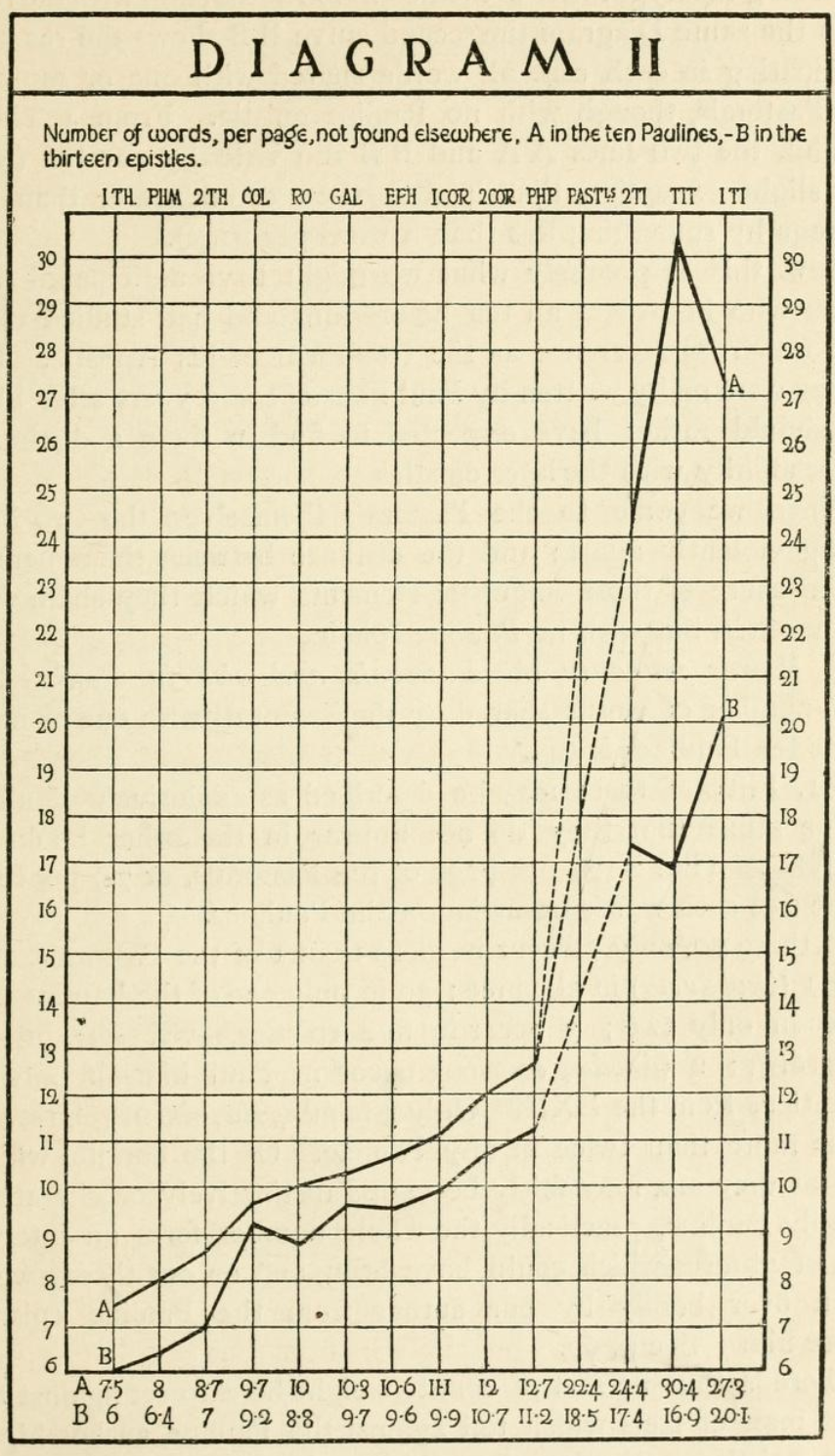
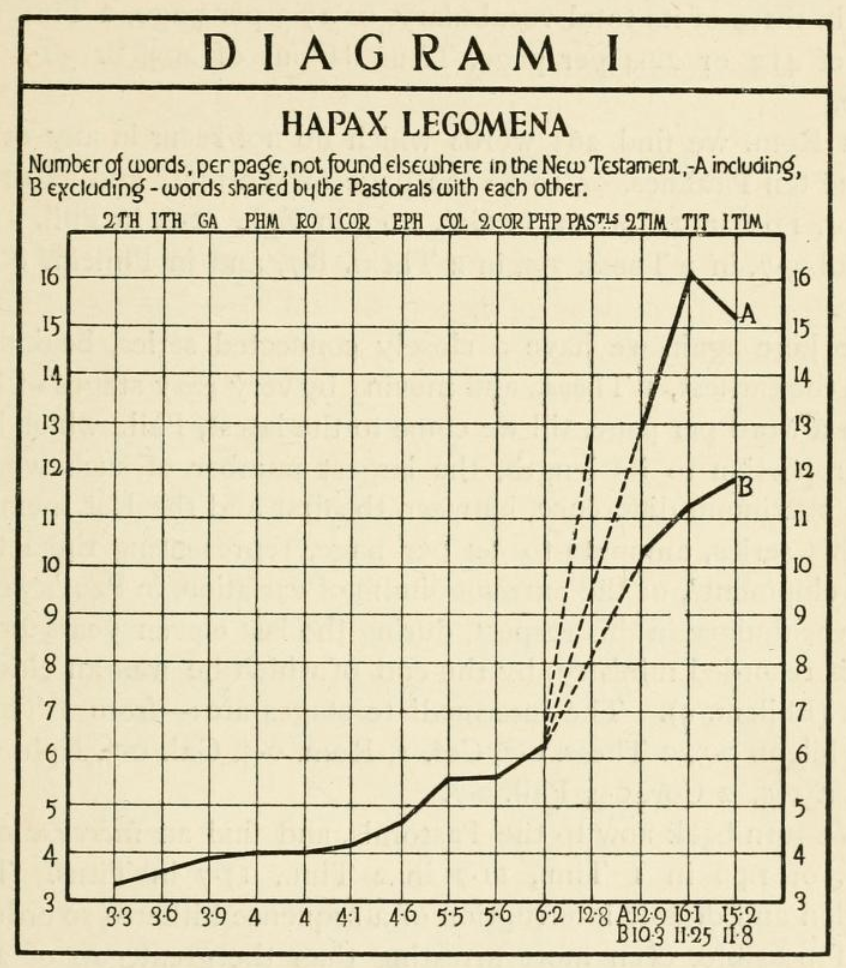
...there are 848 different words used in the pastoral letters. Of that number 306 over one-third of them! do not occur in any of the other Pauline letters of the New Testament. That's an inordinately high number; especially given the fact that about two-thirds of these 306 words are used by Christian authors living in the second century.
So not only is the vocabulary in the Pastorals significantly different from the rest of Paul's letters, the vocabulary being used also lines up with the vocabulary that was being used by second century Christians, nearly 100 years after Paul's death.
Perhaps Paul's change in vocabulary is not a big enough difference to definitively say that someone else may have written the pastorals. But consider the difference in theology between these letters and the rest of Paul's letters:
- In Paul's epistles, Paul uses the term "works of the law" to refer to following Jewish law: circumcision, dietary laws, etc. However, this use of "works" is no where to be seen in the Pastorals. Here Paul uses "works" as simply doing good deeds and being a morally good person.
- In his Corinthian letters, Paul says that it is better to remain single and that being single means that someone can better dedicate themselves to God. However, in the Pastorals, Paul now says that marriage is preferable and that all church leaders should be married. And he specifically says that young widows should marry.
- Paul speaks about everyone being in equal in Christ and women praying, prophesying, and receiving gifts in Corinthians, but then the pastorals appear to say the opposite in maintaining a male hierarchy and reducing the role of women in the church. In fact, Paul never speaks about a church hierarchy at all in his epistles, but then in the Pastorals, maintaining and defining the church hierarchy seems to be the main purpose of the letter.
Why is the vocabulary so radically different in the Pastorals compared to the rest of Paul's writing? Why do the Pastoral letters' vocabulary line up more with later second century vocabulary? Why does the theology between Paul's other epistles and the pastorals not line up as a single coherent theology? What other reasonable conclusion is possible here other than to say that Paul didn't write 1 Timothy, 2 Timothy, and Titus?
2 Thessalonians
There are 2 major reasons that scholars also believe 2 Thessalonians to also not be written by Paul. The first is that the theology between the 2 makes an extremely radical shift. In 1 Thessalonians 4, we can see that Paul is comforting those who have died before Christ's return. A particular note is also that Paul includes himself among the living during Christ's return. Paul is teaching that Christ's return would happen during his own lifetime and that it would "like a thief in the night". It would happen quickly and suddenly.
However, this changes in 2 Thessalonians. Now, additional prophesies must be fulfilled before Christ's return, and the author is calming the readers' minds that Christ is not returning as quickly as they thought. This message would be very useful to Christians questioning why Christ had not returned during Paul's lifetime like he seemed to be saying in 1 Thess.
This verse is the other reason that scholars believe that Paul did not actually write 2 Thessalonians. This is not how Paul ends 1 Thessalonians and it's not how he ends most of his letters. But it seems very convenient for a forger to write this in an attempt to convince readers that is truly Paul's words. It's a very out of place statement for Paul to make.
So why the sudden change in tone between 1 and 2 Thessalonians? Why is 1 Thessalonians insistent on a present and sudden return of Christ, but 2 Thessalonians seems to be stating the opposite that people need to return to work and no longer expect Christ to return until a number of different signs happen? Why does Paul feel the need to prove that the letter is authenticate multiple times in 2 Thessalonians when he didn't seem to need to in most other letters?
Ephesians
There are again 2 reasons that scholars don't believe that Paul wrote Ephesians. The first is that Ephesians has a completely different style of writing from every other epistle.
...in the hundred or so sentences in Ephesians, 9 of them are over 50 words in length. Compare this with Paul's own letters. Philippians, for example, has 102 sentences, on 1 of which is over 50 words; Galatians has 181 sentences, again with only 1 over 50 words.
Ephesians also has a higher number of words that only occur in Ephesians, about 50% higher than his other letters. So, again, we have good reason to be suspicious of the authorship.
But there also seem to be theological differences between some of the ideas in Ephesians and Paul's letters. For example:
In Ephesians, it seems that the author is claiming that Christians have already been saved and that we have already been raised in a spiritual sense. But no where in any of Paul's letters does Paul ever use the term "saved" to refer to a past event. Being "saved" is a process and future actuality. In fact, Ephesians 2:4-6 seems to be arguing against 1 Corinthians 15 where Paul emphatically states that Christians are in the process of being saved and will experience heaven and salvation after they have died and are then resurrected.
If Paul wrote Ephesians, then why does his vocabulary shift so dramatically? Why does Paul seem to talk about being "saved" in a completely different sense from his other letters and seems to refute the theology that he was building?
Colossians
The differences between this letter and Paul's writings are striking and compelling. Just to give you a taste:
How often the letter uses 'adversative conjunctions' (e.g., 'although'): Galatians, 84 times; Philippians, 52; 1 Thessalonians, 29; Colossians, only 8. How often the letter uses causal conjunctions (e.g., 'because'): Galatians, 45 times; Philippians, 20; 1 Thessalonians, 31; Colossians, only 9. How often the letter uses a conjunction (e.g., 'that,' 'as') to introduce a statement: Galatians, 20 times; Philippians, 19; 1 Thessalonians, 11; Colossians, only 3. The lists go on for many pages, looking at all sorts of information, with innumerable considerations all pointing in the same direction: this is someone with a different writing style from Paul's.
The vocabulary and style choices used in Colossians do not line up with Paul's letters much like Ephesians. The theology of Colossians also seems to line up with Ephesians as well using the "saved" in the same manner. This has led scholars to believe that the author of Colossians and Ephesians either borrowed from each other or were the same person.
The author of Colossians also seems to talk about a "philosophy and empty deceit" but does not want to say exactly what this philosophy is or what exactly people are claiming. This isn't a strong proof, but it has the smell of a forgery where the author knows that if he quotes or directly talks about the "philosophy" he is writing against, then it will become obvious that it is a forgery.
The questions for Colossians are same as those in Ephesians. Why does his vocabulary shift so dramatically? Why does Paul seem to talk about being "saved" in a completely different sense from his other letters and seems to refute the theology that he was building?